“I can fly! Listen! I CAN FLY!”
If you want to fly, don’t wait—read this book. Gain speed not just in your wings, but in your thoughts, and discover your purpose to serve.
Jonathan Livingston Seagull by Richard Bach is one of those books that feels simple on the surface, yet keeps unfolding within you for days… even weeks. And that is exactly what happened with me. We all talk and share when we read or watch something beautiful—that is a review. But in my case, the impression lasts a little longer. The thoughts settle at different levels—emotional, logical, social, and spiritual. So I felt, why not write—so that more people become aware of such books and choose what to read according to their inner need at that moment.
Now coming back to the book…
First word: WOW.
It is light, but not shallow. There is pain, but also detachment. There is separation, but also reunion. It carries philosophy, yet gives practical technique. It speaks of logic, yet flows with love, kindness, humility, and a quiet strength that stays.
Richard Bach, being a pilot, writes about flying not just as movement in the sky, but as a deeper purpose of life. Jonathan does not fly to find food like the rest of the flock—he flies to understand how and why. That curiosity itself becomes his path. At one point, it feels like flying is not about wings at all—it is about freedom from fear and limitation.
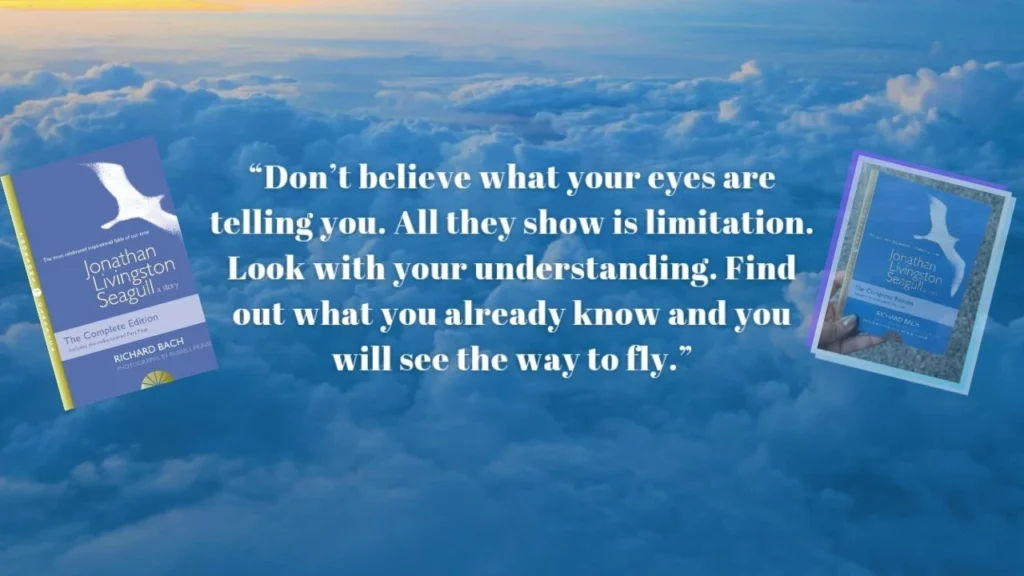
“Don’t believe what your eyes are telling you. All they show is limitation.”
Jonathan Livingston Seagull is a seeker. What makes him special is not just his courage, but his innocence. Even after learning advanced flying, he reacts like a child—amazed, excited, always wanting to learn more.
Jonathan was dazzled. He forgot to ask about heaven. “How do you do that? What does it feel like? How far can you go?”
“Can you teach me to fly like that?” Jonathan Seagull trembled to conquer another unknown.
“Of course, if you wish to learn.”
“I wish. When can we start?”
“We could start now, if you’d like.”
“I want to learn to fly like that,” Jonathan said, and a strange light glowed in his eyes. “Tell me what to do.”
…and more. You can almost hear his inner voice: “There is still so much to know.” That eagerness is beautiful. It reminds us that true learning never ends, and those who truly learn become more humble, not proud.
When the flock rejects him, it reflects our society—how quickly we label, judge, and resist anything different. The flock lives in fear, in blind beliefs, in a fixed idea of what life should be. Jonathan breaks that pattern. And in doing so, he teaches us how to overcome our own blind spots, prejudices, and even subtle superstitions that limit growth.
“The gull sees farthest who flies highest.”
There is a deep message here—when we rise above fear and conditioning, our vision becomes clearer.
Fletcher, his student, represents us. He struggles, doubts, fails, even gets frustrated. But he continues. And that is where transformation begins. Through him, we understand that learning is not instant—it is a process of falling and rising again.
“I just don’t understand how you do it.”
“I want to learn.”
And slowly, learning softens him. It removes arrogance. It builds humility. Because the more we understand, the more we realize how much is still unknown.
Then comes Chiang—the enlightened teacher—who brings one of the most powerful ideas of the book: that heaven is not a place.
“Heaven is not a place, and it is not a time. Heaven is being perfect.”
This line changes everything. Suddenly, perfection is not external achievement—it is inner realization. Time and space begin to lose their rigid meaning.
“You will begin to touch heaven, Jonathan, in the moment that you touch perfect speed. And that isn’t flying a thousand miles an hour, or a million, or flying at the speed of light. Because any number is a limit, and perfection doesn’t have limits. Perfect speed, my son, is being there.”
Here, “speed” is not just physical—it is alignment, awareness, and presence.
About Sullivan’s character, I want you to see his special role and bundle of virtues. Here I am sharing the part I felt so connected to, because I miss my friends, family, and pets a lot—some of them have left this world, and some are very far away. This part made me feel content:
“Sully, for shame!” Jonathan said in reproach, “and don’t be foolish! What are we trying to practice every day? If our friendship depends on things like space and time, then when we finally overcome space and time, we’ve destroyed our own brotherhood! But overcome space, and all we have left is Here. Overcome time, and all we have left is Now. And in the middle of Here and Now, don’t you think that we might see each other once or twice?”
Sullivan Seagull laughed in spite of himself. “You crazy bird,” he said kindly. “If anybody can show someone on the ground how to see a thousand miles, it will be Jonathan Livingston Seagull.” He looked at the sand. “Good-bye, Jon, my friend.”
What touched me deeply is that Jonathan, after learning so much, comes back—not to prove himself, but to teach. This is where the book speaks about passing knowledge to the next generation. Learning becomes meaningful only when shared. Growth becomes complete only when it uplifts others.
“The only true law is that which leads to freedom.”
This is love—not emotional attachment, but helping others become free.
The book also quietly speaks about evolution—not of the body, but of consciousness. From survival to purpose. From fear to freedom. From limitation to possibility. Jonathan evolves and then becomes a guide for others to evolve.
“Do you have any idea how many lives we must have gone through before we even got the first idea that there is more to life than eating, or fighting, or power in the flock? A thousand lives, Jon, ten thousand!… We choose our next world through what we learn in this one…”
There is also a subtle lesson about perfection. It is not about being flawless. It is about continuous effort, continuous learning, continuous becoming. And in that process, we become lighter—not heavier with ego.
What I loved most is Jonathan’s gentle, almost “cute” amazement, even at higher levels. He never becomes rigid or serious in a heavy way. He remains open, curious, and joyful. That innocence is his real mastery.
And maybe that is the biggest takeaway—
To keep learning.
To keep questioning.
To rise above fear.
We all are unique.
Some displays are more reflective than others, but don’t forget we all serve the capacity we have received. So if we feel better in some things, it brings more responsibility to share.
And yet… to remain soft, kind, and curious.
This book does not loudly preach. It quietly transforms. Here I am leaving so many parts without discussion—brotherhood, seeing the positive in others, joy in learning, preparation for the next world in this very present life, and many more… and don’t forget—“Keep working on love.”
If you have read something beautiful, share it. If you haven’t read this yet, maybe this is your moment.
And if you have read it—tell me,
which part made you feel like you could fly?