
There is a big difference between becoming aware and taking steps or starting self-medication. Self-medication and self-therapy can be dangerous and should not be done at all. This is different—it is more about becoming aware of your condition and then starting to take steps, because you can do it. If you do it with the help of your therapist, you will definitely be on a path of progressive and faster recovery.
Even in general, to help friends and family—especially not to push too far those who are already going through a tough time—this book can make you aware of your own thoughts and help you guide them without judgment. It is simple yet profound, covering both theory and practical aspects through worksheets. Therapists and psychologists can use this book to sharpen their methods. The worksheets are really helpful in tracking progress in a case. Therapy and counseling are arts practiced in live sessions with very delicate souls—it is always good to keep learning with an open mind.
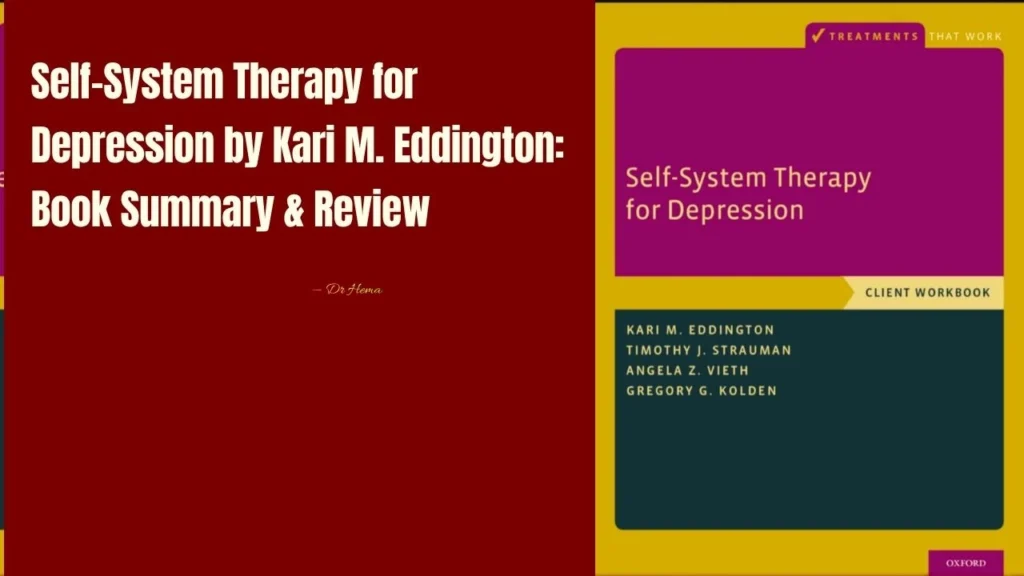
Self-System Therapy for Depression by Kari M. Eddington, Timothy J. Strauman, Angela Z. Vieth, and Gregory G. Kolden is an evidence-based workbook designed to help individuals understand and overcome depression through a structured, compassionate, and practical approach. The book does not place blame on the individual; rather, it emphasizes growth, awareness, and steady, meaningful progress. It is especially effective when used alongside a therapist, as it combines psychological insight with exercises, reflections, and real-life applications that support gradual and sustainable improvement.
The book begins by explaining depression in a clear and relatable way. Depression is described as more than simply feeling sad—it is a condition that affects emotions, motivation, thinking, and daily functioning. Common symptoms include persistent sadness, loss of interest in activities, changes in sleep and appetite, fatigue, difficulty concentrating, feelings of guilt or worthlessness, and even thoughts of death. A key and powerful idea presented is that depression acts like a “motivation thief,” taking away the ability to enjoy life and making even simple tasks feel empty or meaningless.
To identify clinical depression, the book provides a checklist: at least five symptoms—one of which must be sadness or loss of interest—must be present most of the day, nearly every day, and must interfere with daily life activities. This structured understanding allows individuals to recognize their condition with clarity and without self-judgment.
At the core of the therapy lies the concept of self-regulation, defined as a motivational process involving the setting and pursuit of goals that help a person become who they want to be. More specifically, self-regulation involves ongoing comparisons between the actual self (the person one is), the ideal self (the person one wishes to be), and the ought self (the person one feels they should be). When this system is disrupted—as often happens in depression—individuals struggle to pursue meaningful goals, leading to disappointment, frustration, and a persistent sense of failure. The therapy gently works to rebuild this system step by step, helping individuals reconnect with their goals and regain a sense of direction.
Closely related to this are self-beliefs, which refer to the characteristics that define the actual self—how individuals perceive, describe, and evaluate themselves. In depression, these self-beliefs often become negative, rigid, and self-critical, reinforcing feelings of inadequacy and hopelessness. The therapy seeks to examine the content, origins, and usefulness of these beliefs, gradually reshaping them into more balanced and compassionate perspectives.
Alongside this, the concept of self-guides is introduced. Self-guides are internal standards that define the ideal self and the ought self—essentially, they are the personal expectations and values that guide behavior. While these guides can be motivating, they can also become overly strict or unrealistic, creating internal pressure and distress.
This leads to the important concept of self-discrepancies, which are the gaps between the actual self and one’s self-guides. When there is a discrepancy between the actual self and the ideal self, individuals often experience sadness, disappointment, and a sense of unfulfilled potential. When the discrepancy is between the actual self and the ought self, feelings of guilt, anxiety, and tension are more likely to arise. Self-System Therapy does not attempt to eliminate these guides but instead helps individuals adjust them so that they become supportive and realistic rather than discouraging and overwhelming. These core concepts—self-regulation, self-beliefs, self-guides, and self-discrepancies—are central to understanding how depression develops and how it can be effectively addressed.
Self-System Therapy (SST) is presented as an appropriate treatment for individuals diagnosed with major depressive disorder or persistent depressive disorder, ranging from mild to severe levels of symptom intensity. It is particularly suited for individuals whose depression is characterized by difficulties in self-regulation, although it can also be applied in cases where anxiety or other conditions are present. The approach emphasizes the importance of a thorough diagnostic evaluation and medical examination to rule out nonpsychological causes of mood disturbance. Assessment includes confirming diagnostic criteria, identifying any contraindications, and developing a comprehensive understanding of the individual’s current challenges as well as their strengths.
The therapy itself is structured into three main phases—orientation, exploration, and adaptation—allowing for steady and practical progress while maintaining flexibility to suit individual needs.
In the orientation phase, the primary goals are to familiarize the client with the structure and focus of SST and to establish a strong, collaborative working relationship. During this phase, the therapist educates the client about self-regulation, begins reinstating goal-directed activities (especially those linked to positive experiences), conducts a self-in-context assessment, and develops an initial problem formulation. The therapist also explores the origins of the client’s self-guides and standards, helping to identify how these contribute to difficulties in self-regulation and depression. A key focus here is addressing the breakdown in motivation that characterizes depression and gradually increasing engagement in meaningful activities.
In the exploration phase, the therapy deepens its focus on understanding the client’s internal processes. This phase involves a detailed assessment of self-knowledge and regulatory style. Two important techniques are used: self-belief analysis and psychological situation analysis. Self-belief analysis examines the content, function, and origins of beliefs about oneself, especially in relation to personal goals and standards. Psychological situation analysis looks at how the individual responds to everyday situations, identifying patterns in how goals are pursued or avoided. Through this process, the therapist and client collaboratively refine the problem formulation and identify specific targets for reducing self-discrepancies and improving the effectiveness of self-regulation.
The adaptation phase focuses on active change and growth. The main aim is to reduce chronic and distressing self-discrepancies and to modify ineffective patterns of self-regulation. The therapist may use different strategies depending on the client’s needs, including altering maladaptive aspects of self-regulation or helping the client compensate for areas that are less easily changed. This phase includes three flexible modules: reducing self-discrepancy and increasing self-congruence, modifying regulatory style, and managing perfectionistic tendencies. These modules can be applied in any order, allowing therapy to be tailored to the individual. Through this process, clients learn to set more realistic standards, pursue goals more effectively, and develop healthier patterns of thinking and behavior.
The final stage of therapy addresses treatment conclusion and relapse prevention. This stage focuses on maintaining progress and ensuring that the skills developed during therapy continue to be applied in everyday life. Since individuals with depression often struggle to recognize their own progress, therapists emphasize the client’s active role in their improvement and encourage acknowledgment of their efforts. The goal is to equip clients with the ability to continue regulating their goals, evaluating themselves realistically, and moving closer to the person they want to be even after therapy ends.
An important feature of SST is how it relates to and differs from other structured therapies such as cognitive-behavioral therapy, interpersonal therapy, behavioral activation, and acceptance and commitment therapy. While it shares similarities in structure and goal orientation, SST uniquely focuses on self-regulation as a motivational system and specifically targets how individuals set, pursue, and evaluate their personal goals. This makes it particularly effective for individuals whose depression is linked to feelings of failure, lack of direction, or disconnection from meaningful aspirations.
One of the most valuable aspects of the book is its strong emphasis on practical application. Through worksheets and between-session assignments, individuals actively participate in their own healing process. They are encouraged to reflect on what depression has taken from their lives, monitor their goals, and observe how their thoughts, behaviors, and emotions are interconnected. These activities promote self-awareness, responsibility, and gradual, consistent improvement. The collaborative nature of the therapy further reinforces the idea that the individual is the true expert of their own experience, while the therapist provides guidance and support.
Overall, the book presents a deeply hopeful and empowering perspective. It does not view individuals as flawed or broken but as capable of growth, change, and self-alignment. By understanding and working with self-regulation, reshaping self-beliefs, refining self-guides, and reducing harmful self-discrepancies, individuals can gradually rebuild their sense of purpose and emotional well-being. The steady, structured, and compassionate nature of this therapy makes it especially beneficial for those struggling with motivation, self-doubt, and a sense of disconnection from their goals. Ultimately, it serves not only as a guide for recovery but as a pathway toward becoming more aligned with one’s true self and living a more meaningful life.
“Stand up and express the divinity within you”—both sides of the table need this.