

Let’s Start This Article with a Case
Since morning, I tried to write this article in at least thirty different ways — but I’m finally sharing this one because my dog, Happy, and I have agreed on it! 🐾
It’s always good to have a second opinion, right?
When it comes to diabetes, you can find countless articles on the internet — full of statistics, diet charts, and medical details. But here, my focus is not just on information — it’s on the quality of life.
A Real Case from My Clinic
About four years ago, one of my old OPD patients brought his friend to see me.
I always enjoy my OPD — sometimes my patients seem more confident about their recovery than I am! Their unconditional hope keeps reminding me how deeply healing begins with faith. and How my own knowledge can be barrier in the unconditional Hope.
This new patient had already lost one foot to diabetic gangrene two years earlier. Now, the other foot had turned completely black — there was no nerve or temperature sensation, and it was badly swollen. His blood sugar level was over 550 mg/dl.
Still, he and his friend were sure he would recover. The patient, very calm in his manner, shared that earlier he used to think diabetes was a “rich person’s disease.” He believed that simply avoiding sugar, potatoes, and fried food are just myths to make patients panic . Because of this misunderstanding and lack of timely treatment, he eventually lost one foot. Even after that, he didn’t take his condition seriously — until recently, when his friend learned more about diabetes and explained it to him. (And yes, we always listen to our friends — that’s good, isn’t it?)
I meet many such people every day — in my OPD, among my relatives, and especially my uncles! Their attitude toward diabetes often reminds me that arguments rarely change minds. Sometimes, illness cannot be completely avoided, especially when genetics play a role.
But what we can do is manage our health better — to live a fuller, happier life with small, consistent lifestyle changes.
So, let’s read further and explore some essential understanding about diabetes and how dietary changes can help prevent and manage it effectively.
Diabetes is a chronic condition that occurs when the pancreas doesn’t produce enough insulin or when the body cannot effectively use the insulin it produces. Insulin helps regulate blood glucose levels.
When diabetes remains uncontrolled, it leads to hyperglycaemia (high blood sugar), causing long-term damage to the body’s nerves, blood vessels, eyes, kidneys, and other organs.
🩸 Understanding Blood Sugar Levels
Normal fasting blood sugar is below 100 mg/dL, while levels 1–2 hours after eating usually range between 90–140 mg/dL.
Condition Fasting Blood Sugar (mg/dL)
Normal Below 100
Prediabetes 100 – 125
Diabetes 126 or higher (on two separate tests)
⚠️ Low & High Blood Sugar Alerts
Hypoglycemia (Low Blood Sugar):
Below 70 mg/dL — may cause shakiness, confusion, anxiety, or tremors.
Severe High Blood Sugar:
Above 240 mg/dL — check for ketones (especially if sick).
Levels above 1000 mg/dL can be life-threatening and may cause Diabetic Ketoacidosis (DKA) — requires immediate medical attention.
🩸 Understanding HbA1c (Glycated Hemoglobin)
HbA1c is a blood test that shows your average blood sugar level over the past 2–3 months. It measures how much sugar is attached to hemoglobin in red blood cells — higher values mean higher average blood sugar.
HbA1c Ranges:
Normal: Below 5.7%
Prediabetes: 5.7%–6.4%
Diabetes: 6.5% or higher
Symptoms
Symptoms may develop suddenly, especially in type 1 diabetes, or appear slowly over years in type 2 diabetes.
Common signs include:
Excessive thirst & hunger
Frequent urination
Blurred vision
Fatigue or tiredness
Unexplained weight loss
Poor wound healing
Leg pains
Weakness & lethargic
Frequent infections
Tingling or numbness
Dry or itchy skin
If you experience any of these symptoms(combination of some), it is important to see a doctor for a proper diagnosis.
Untreated diabetes can damage major organs and increase the risk of heart disease, stroke, kidney failure, and vision loss. Many also develop foot problems due to nerve damage and poor blood flow, which can lead to ulcers or amputations.
Types of Diabetes
Type 1 Diabetes
In Type 1 diabetes, the pancreas produces little or no insulin, a hormone that allows blood sugar (glucose) to enter cells and be used for energy.
Without insulin, glucose stays in the bloodstream, leading to high blood sugar, which over time can damage organs and cause serious complications.
Type 1 diabetes, earlier known as insulin-dependent or juvenile diabetes, usually appears in children, teenagers, or young adults, though it can occur at any age.
It is less common than Type 2 diabetes, accounting for only about 5–10% of all diabetes cases.
Type 2 Diabetes
This is the most common form, accounting for over 95% of diabetes cases. It occurs when the body cannot use insulin effectively, leading to elevated blood sugar levels.
It develops gradually and is often linked to being overweight, lack of physical activity, and genetic factors.
Early detection through regular health check-ups and blood tests is vital to prevent complications.
Once considered an adult disease, type 2 diabetes is now increasingly seen in children and adolescents.
Gestational Diabetes
This form develops during pregnancy and is identified through prenatal screening.
It increases the risk of complications for both mother and baby, and affected women are more likely to develop type 2 diabetes later in life.
Impaired Glucose Tolerance (IGT) and Impaired Fasting Glycaemia (IFG)
These are pre-diabetic conditions where blood sugar levels are higher than normal but not high enough for a diabetes diagnosis.
Without lifestyle changes, people with IGT or IFG are at high risk of developing type 2 diabetes.
Prevention
Type 2 diabetes can often be prevented or delayed through simple lifestyle changes:
Maintain a healthy body weight
Engage in at least 150 minutes of moderate physical activity each week
Follow a balanced diet low in sugar and saturated fats
Avoid tobacco, alcohol use
Manage stress
Get enough sleep
Maintain Daily Routine
Dietary Recommendations to Prevent Diabetes
Dietary advice for a diabetic should always be clear, simple, and practical, as it needs to be followed throughout life. Since the nutritional value of foods and cooking methods can vary, precise calorie and nutrient calculations are not always possible. Weighing each food item daily is also impractical. Instead, it is better to use common household measures (such as cups, spoons, or katori) for guidance.
The more flexibility and variety a person has in choosing foods, the easier it becomes to follow the diet consistently.
👉 This chart is mainly useful for Type 2 diabetes, diabetes with hypertension, or diabetes with PCOD.
⚠️ Kidney patients should not follow this plan.
This is only a general guide. For patients with multiple health conditions, it is always best to get a personalized diet chart prepared by a doctor or dietitian.
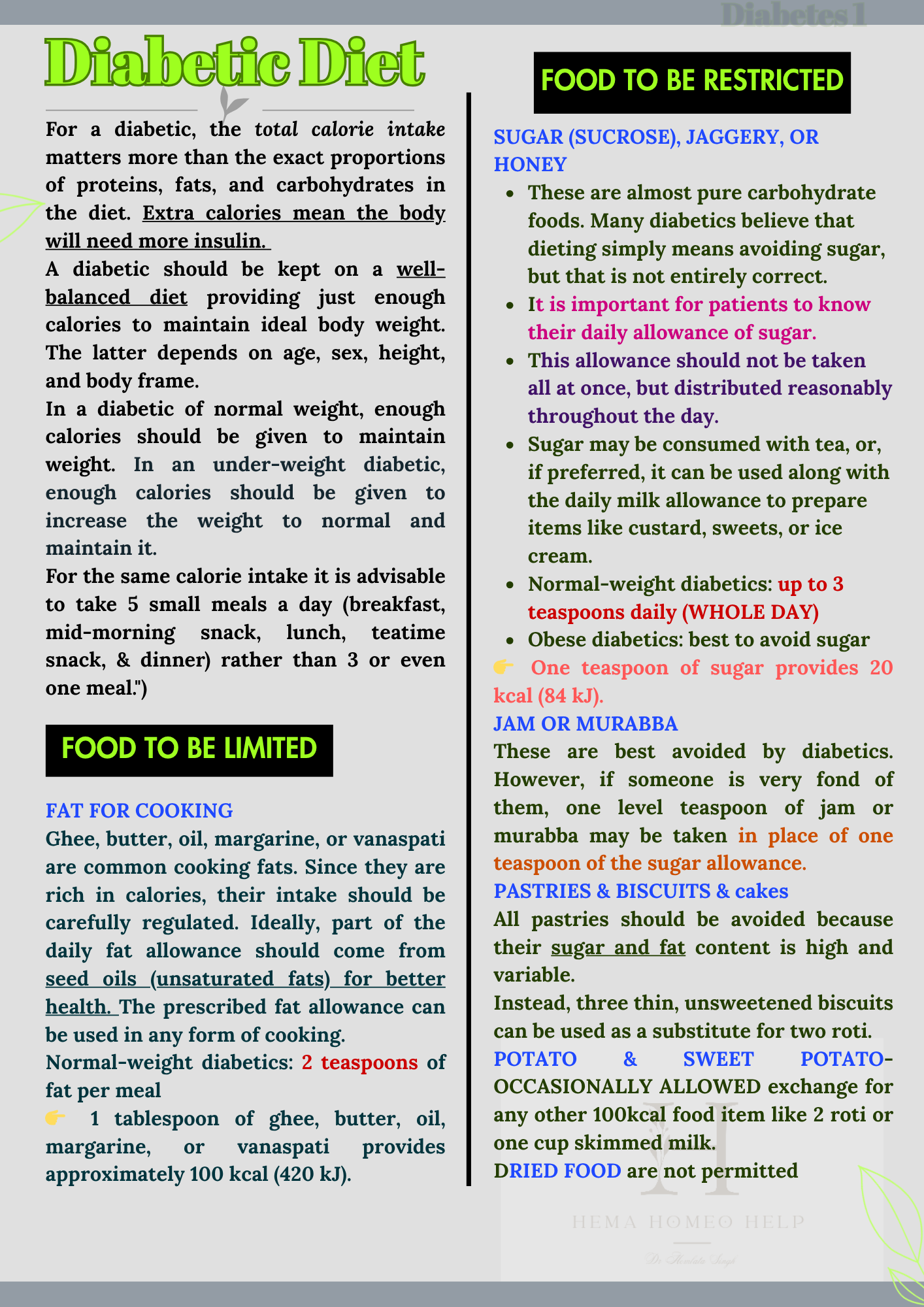
For a diabetic, the total calorie intake matters more than the exact proportions of proteins, fats, and carbohydrates in the diet. Extra calories mean the body will need more insulin.
A diabetic should be kept on a well-balanced diet providing just enough calories to maintain ideal body weight. The latter depends on age, sex, height, and body frame.
In a diabetic of normal weight, enough calories should be given to maintain weight. In an under-weight diabetic, enough calories should be given to increase the weight to normal and maintain it.
For the same calorie intake it is advisable to take 5 small meals a day (breakfast, mid-morning snack, lunch, teatime snack, & dinner) rather than 3 or even one meal.”)
FOOD TO BE LIMITED
FAT FOR COOKING- Ghee, butter, oil, margarine, or vanaspati are common cooking fats. Since they are rich in calories, their intake should be carefully regulated. Ideally, part of the daily fat allowance should come from seed oils (unsaturated fats) for better health. The prescribed fat allowance can be used in any form of cooking.
Normal-weight diabetics: 2 teaspoons of fat per meal
- 👉 1 tablespoon of ghee, butter, oil, margarine, or vanaspati provides approximately 100 kcal (420 kJ).
FOOD TO BE RESTRICTED
SUGAR (SUCROSE), JAGGERY, OR HONEY-These are almost pure carbohydrate foods. Many diabetics believe that dieting simply means avoiding sugar, but that is not entirely correct.
- It is important for patients to know their daily allowance of sugar.
- This allowance should not be taken all at once, but distributed reasonably throughout the day.
- Sugar may be consumed with tea, or, if preferred, it can be used along with the daily milk allowance to prepare items like custard, sweets, or ice cream.
- Normal-weight diabetics: up to 3 teaspoons daily (WHOLE DAY)
- Obese diabetics: best to avoid sugar
👉 One teaspoon of sugar provides 20 kcal (84 kJ).
JAM OR MURABBA-These are best avoided by diabetics. However, if someone is very fond of them, one level teaspoon of jam or murabba may be taken in place of one teaspoon of the sugar allowance.
PASTRIES & BISCUITS & cakes – All pastries should be avoided because their sugar and fat content is high and variable.
Instead, three thin, unsweetened biscuits can be used as a substitute for two roti.
POTATO & SWEET POTATO- OCCASIONALLY ALLOWED exchange for any other 100kcal food item like 2 roti or one cup skimmed milk.
PERMITTED WITH CONDITIONS
BREAD & CHAPATTIES
A NORMAL-WEIGHT diabetic is allowed small two wheat/one jwar/one bajara/one multigrain bread.
RICE can exchange in place of allowed roti/bread. twice in a week
MILK & milk products – skimmed milk, buttermilk and curd – two cups
PULSES(DAL), DRIED PEAS & BEANS – one cup of dal twice a day allowed
- in mixed diet can exchange one cup with one cup milk/one egg
VEGETABLES
- vegetables are best source of bulk with carbohydrate calories.
- leafy vegetables like spinch & cabbage can be eaten freely
- ROOT vegetables – such as carrot, radish, onion, turnip etc. can be eaten freely.
👉 except for POTATO & SWEET POTATO
- other vegetables – such as pumpkin, brinjal, lady’s fingers, beans etc. can be eaten freely.
👉 dont have OVERRIPE BEANS without calorie exchange in day meal
- Vegetable SALAD of cucumber, lettuce, onion, radish, tomato with lemon, green chillies, sprouts, dried pepper can be used on a regular basis lunch/dinner/short breakfast
FRUITS – one of the following fruits of an average size is allowed two times a day: tangerine, orange, sweet lime, apple, guava, ½ small papaya, ½ medium melon, ¼ small watermelon, small bunch 20 grapes.. avoid BANANA & MANGO at all.
NUTS – These are allowed as exchange food.
PAPAD, CHUTNETY & PICKLES – these are allowed in moderation
BEVERAGES- like tea & coffee are permitted, with milk & sugar taken from the DAILY RATION. unsweetened drinks such as soda water, lime water not be restricted.
[caption id="attachment_331" align="aligncenter" width="1414"]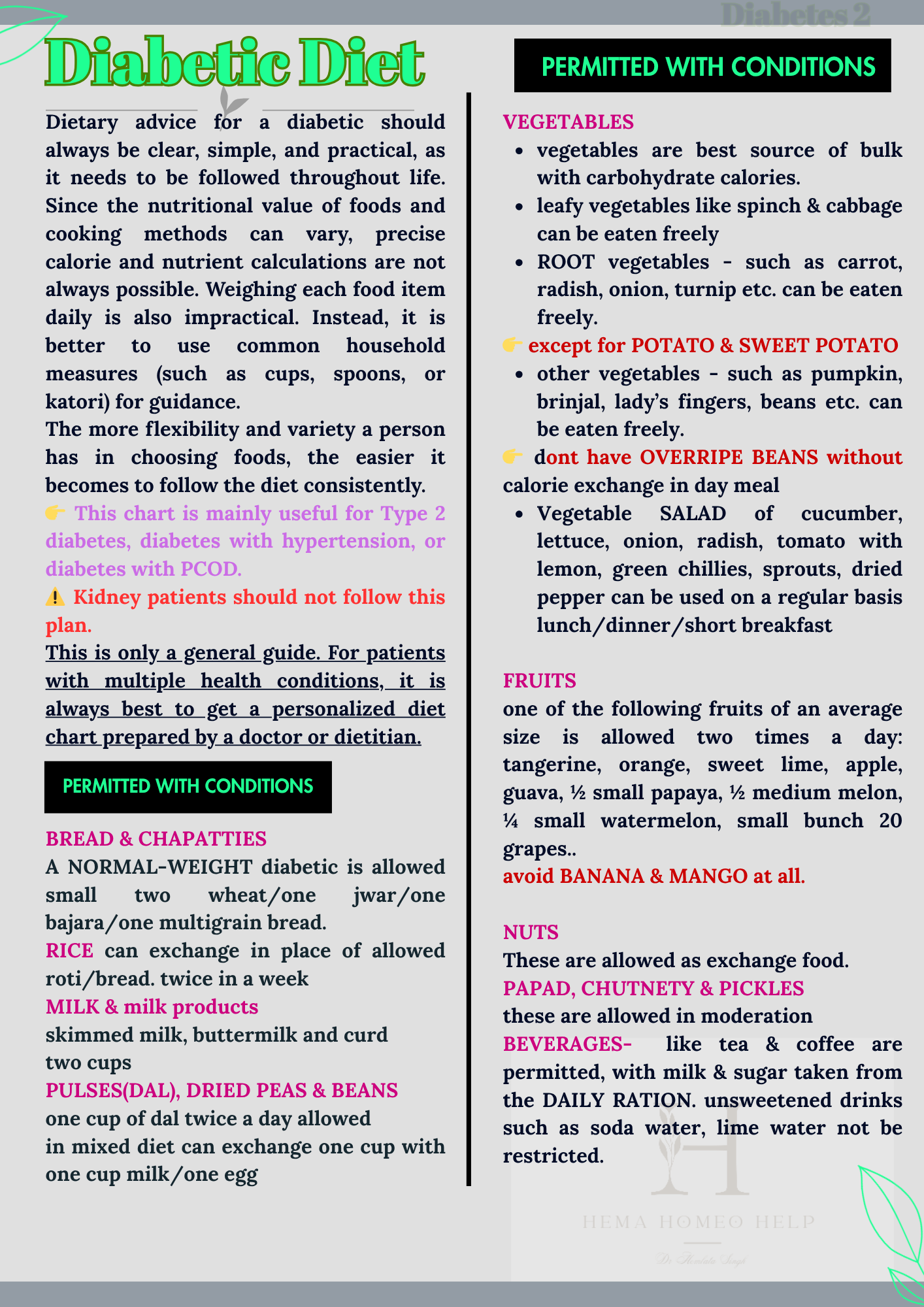 Diabetic diet 2
Daily ration
2 tea spoon sugar/day
2 tea spoon refined oil/lunch /dinner
2 cup milk/day
2 cup cooked dal
2 small size fruits
Seeds, nuts, egg exchange food

A fiber-rich, plant-forward, low-sugar, and minimally processed diet not only prevents diabetes but can also help reverse early stages of the disease.
Usually, I see three types of diabetic patients in my practice.
The first category includes those who manage their diabetes purely through diet and lifestyle modifications — and they’ve been doing well for many years without medication.
The second category manages mostly with lifestyle control, but during times of stress or emotional imbalance, they may temporarily need medication for better control.
The third category needs both medicine and lifestyle modification together — and with proper follow-up, they also stay well-managed.
Whatever path of treatment you follow — whether it’s Homeopathy, Ayurveda, or Allopathy — take it sincerely, stay consistent, and never self-medicate or quit treatment on your own.
Diabetes is one of the fastest-growing health challenges worldwide, but with awareness, lifestyle modification, early detection, and proper care, it can be effectively managed.
Empower yourself with knowledge — prevention starts with you.
READ, WATCH, LISTEN, UNDERSTAND & EMPOWER