

MotivationA Question for Every Leader
When you wake up each morning thinking about your institution, your team, and the responsibilities ahead, what is the first thought that crosses your mind?
Perhaps it is about pending work, an important meeting, a deadline, or the challenges waiting for you at the office.
Now imagine waking up on a Saturday, knowing that you have to work on Sunday as well, without a compensatory day off. How would you feel? Would you begin the day with the same enthusiasm as you did on Monday?
We all know that responsibilities do not disappear simply because we feel tired. Whether we are employees, team leaders, or heads of institutions, the work must continue.
But this brings me to a question I often find worth reflecting on:
How can we keep ourselves and our teams motivated when salaries remain fixed, routines become predictable, and rewards are limited?
More importantly, how can we create a workplace where people do not merely come to fulfil their duties but feel happy to contribute?
I believe motivation is not always about offering more money. Sometimes, it begins with how we treat people, how we organise our working environment, and how we make an ordinary day a little more enjoyable.
As Maya Angelou famously said:
“People will never forget how you made them feel.”
This thought is particularly relevant to the workplace. People may forget the details of a meeting or the instructions they received, but they often remember whether they felt respected, appreciated, ignored, or encouraged.
So, what small changes can make a meaningful difference?
As management thinker Peter Drucker observed:
“The best way to predict the future is to create it.”
Although Drucker expressed this idea in a broader context, it offers a useful perspective on workplace motivation. Instead of waiting for enthusiasm to return on its own, organisations can deliberately create an environment in which people feel encouraged to contribute, improve, and grow.
Let us explore some practical ways to make this possible.
1. Appreciation: Make Good Work Visible
One of the simplest ways to encourage employees is to acknowledge their efforts.
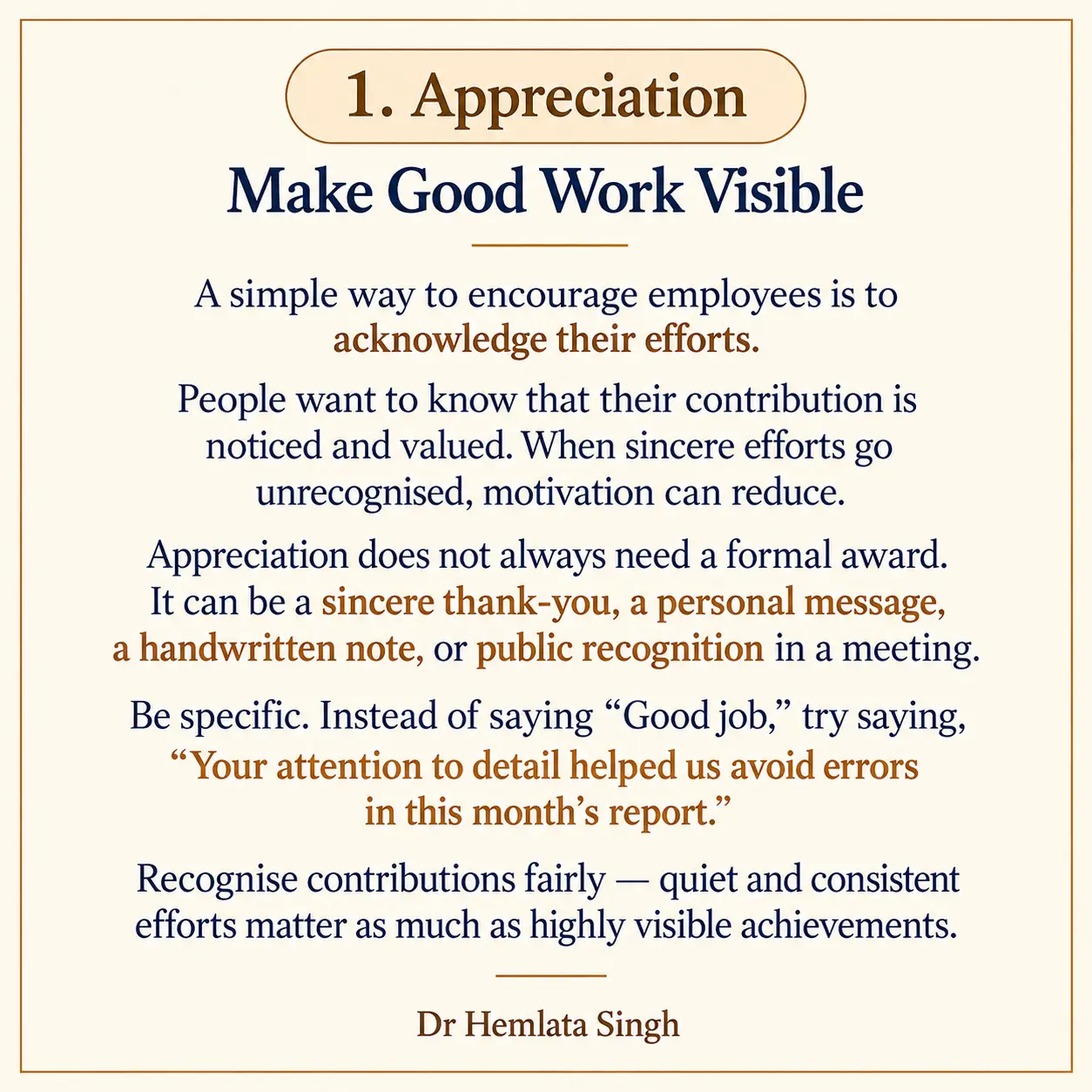
People may receive a salary for their work, but they also want to know whether their contribution is noticed and valued. When sincere efforts repeatedly go unrecognised, employees may begin to feel that doing more makes little difference.
Appreciation does not always require a formal award or an expensive gift. It can be a sincere thank-you, a handwritten note, a personal message, or public recognition during a team meeting.
The important thing is to be specific.
Instead of saying, “Good job,” a manager might say, “Your attention to detail helped us avoid errors in this month’s report.”
Specific appreciation tells employees exactly what they did well and encourages them to continue doing it.
Recognition should also be fair. Quiet, consistent contributions deserve attention just as much as highly visible achievements.
2. Achievement-Based Incentives: Reward Meaningful Contributions
When salaries cannot be changed, organisations can consider introducing small, clearly defined rewards for achievements that go beyond routine expectations.
These might include:
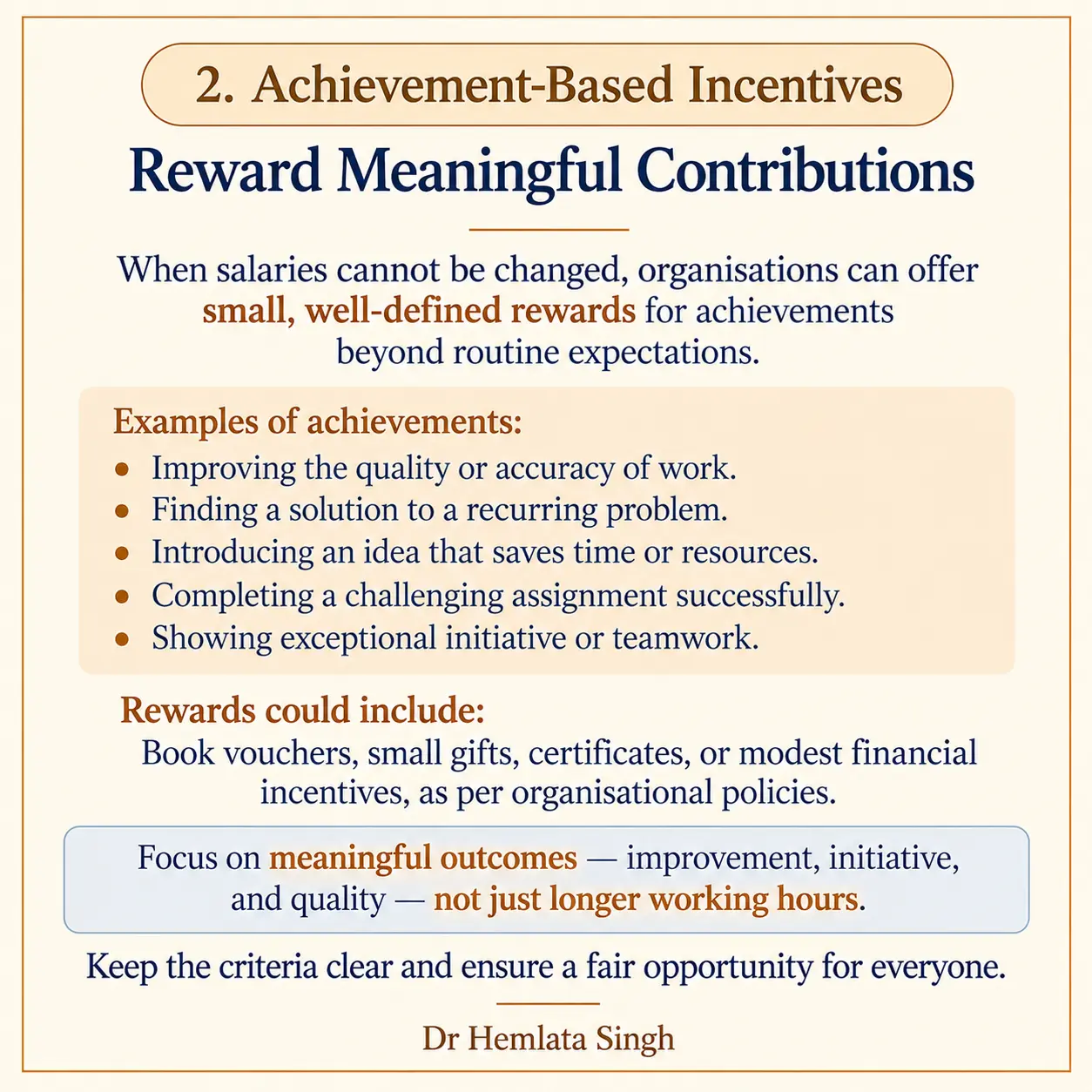
- Improving the quality or accuracy of work.
- Finding a solution to a recurring problem.
- Introducing an idea that saves time or resources.
- Completing a challenging assignment successfully.
- Demonstrating exceptional initiative or teamwork.
Rewards could take the form of book vouchers, small gifts, certificates, or modest financial incentives, depending on the organisation’s resources and policies.
However, incentives must be designed carefully. Rewarding employees simply for working longer hours may encourage presenteeism rather than productivity.
A better approach is to reward meaningful outcomes, improvement, initiative, and quality.
Employees should understand the criteria in advance, and everyone should have a fair opportunity to be recognised.
3. Growth Opportunities: Give People Something New to Look Forward To
Repetition can make even a satisfying job feel monotonous.
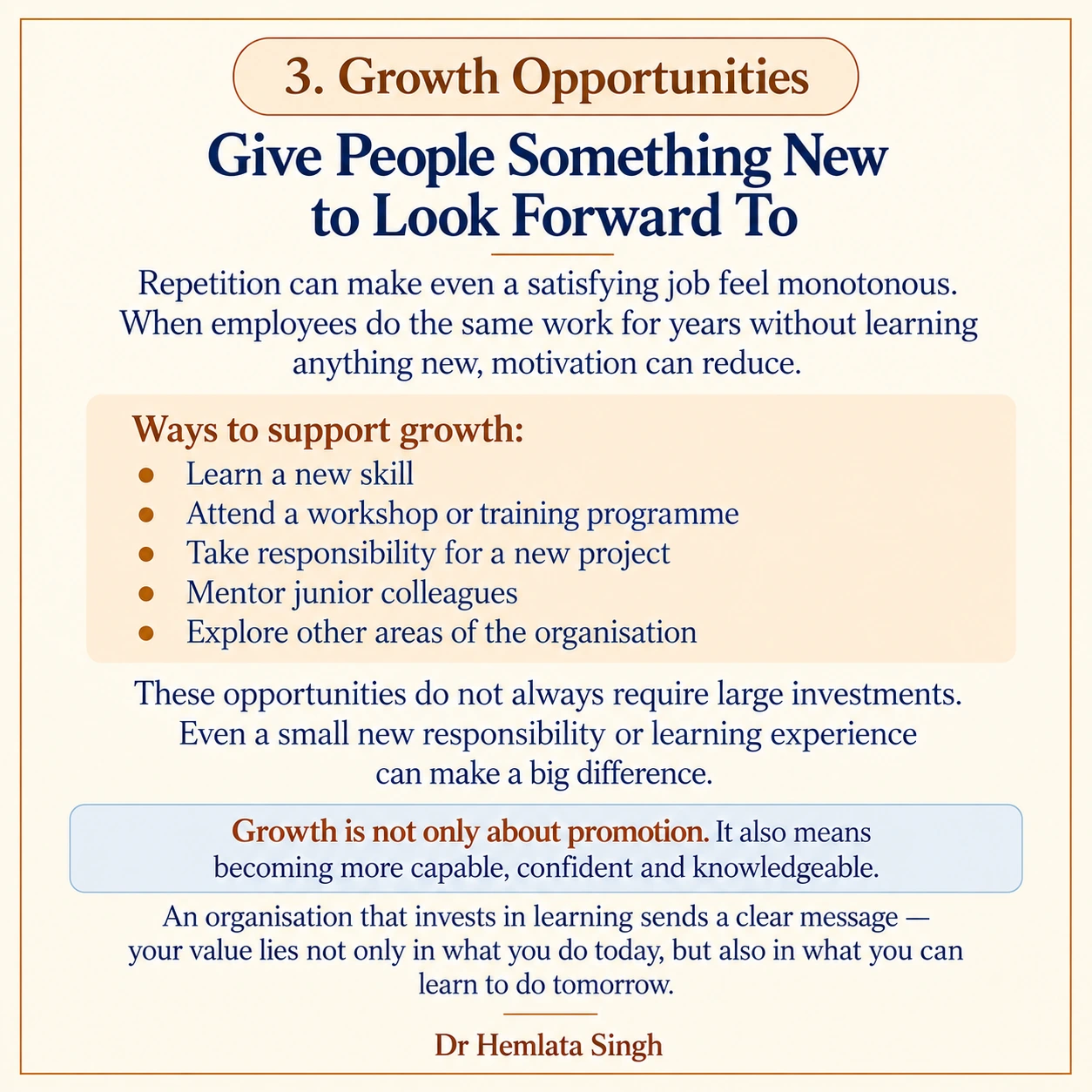
When employees perform the same tasks for years without learning anything new, they may begin to feel that their professional lives have reached a standstill.
One solution is to introduce opportunities for learning and development.
An employee could be encouraged to acquire a new skill, attend a workshop, participate in a training programme, or take responsibility for a new project.
Where appropriate, employees could also be given opportunities to mentor junior colleagues or learn about other aspects of the organisation.
These opportunities need not involve expensive programmes. Sometimes, allowing an employee to lead a small project or learn a new process can make a meaningful difference.
Growth does not always mean promotion. It can also mean becoming more capable, confident, independent, and knowledgeable.
An organisation that invests in its employees sends a powerful message: their value lies not only in what they can do today, but also in what they can learn to do tomorrow.
4. Time as an Incentive: Recognise That Life Extends Beyond Work
Money is valuable, but so is time.
For some employees, an additional day off or greater flexibility may be more meaningful than a small monetary reward.
Where organisational requirements and applicable policies permit, employers could consider:
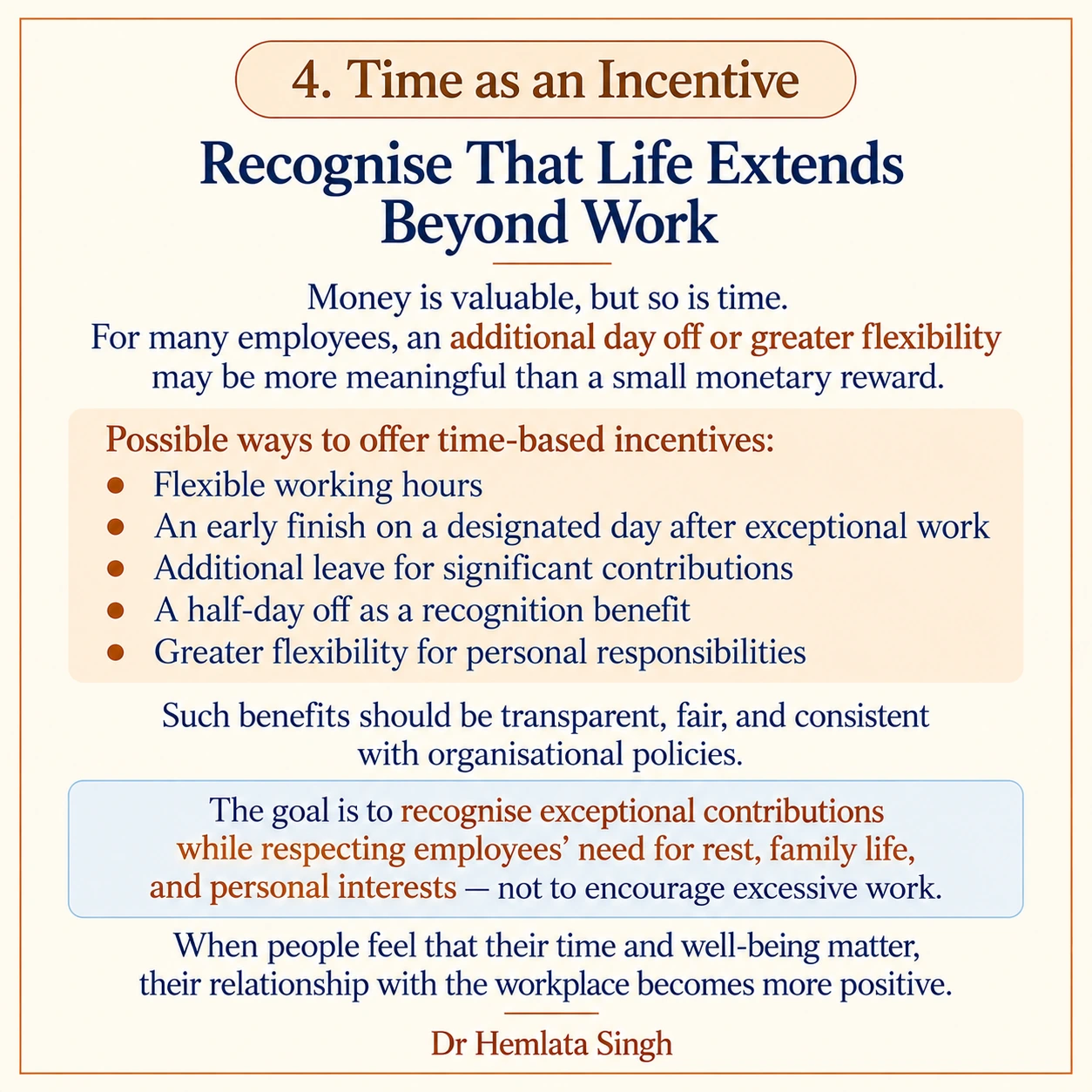
- Flexible working hours.
- An early finish on a designated day after an exceptional achievement.
- Additional paid leave for significant contributions.
- A half-day off as a recognition benefit.
- Greater flexibility in managing personal responsibilities.
Such benefits should be transparent, equitable, and consistent with employment rules.
The objective is not to make employees work excessively in exchange for time off. It is to recognise exceptional contributions while respecting their need for rest, family life, and personal interests.
When people feel that their time and well-being matter, their relationship with the workplace can become more positive.
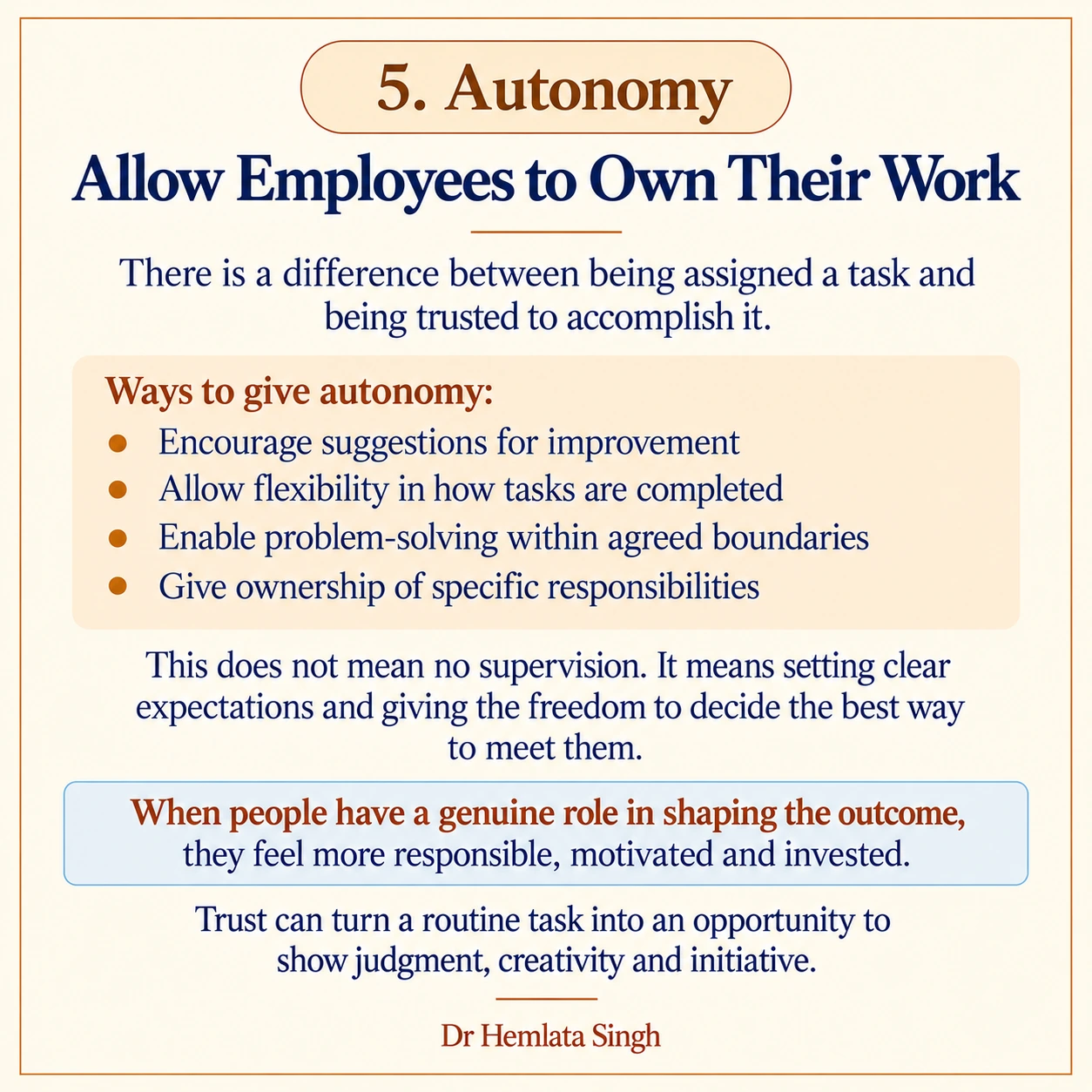
5. Autonomy: Allow Employees to Own Their Work
There is a difference between being assigned a task and being trusted to accomplish it.
When employees are told exactly what to do at every step, they may gradually stop thinking independently. They learn to follow instructions rather than look for better ways to work.
Giving employees reasonable autonomy can help reverse this pattern.
Managers can allow team members to suggest improvements, choose appropriate methods for completing tasks, solve problems independently within agreed boundaries, and take ownership of specific responsibilities.
This does not mean abandoning supervision or standards. It means establishing clear expectations while giving employees the freedom to decide how best to meet them.
People are often more invested in outcomes when they have a genuine role in shaping them.
Trust can transform a routine assignment into an opportunity to demonstrate judgment, creativity, and responsibility.
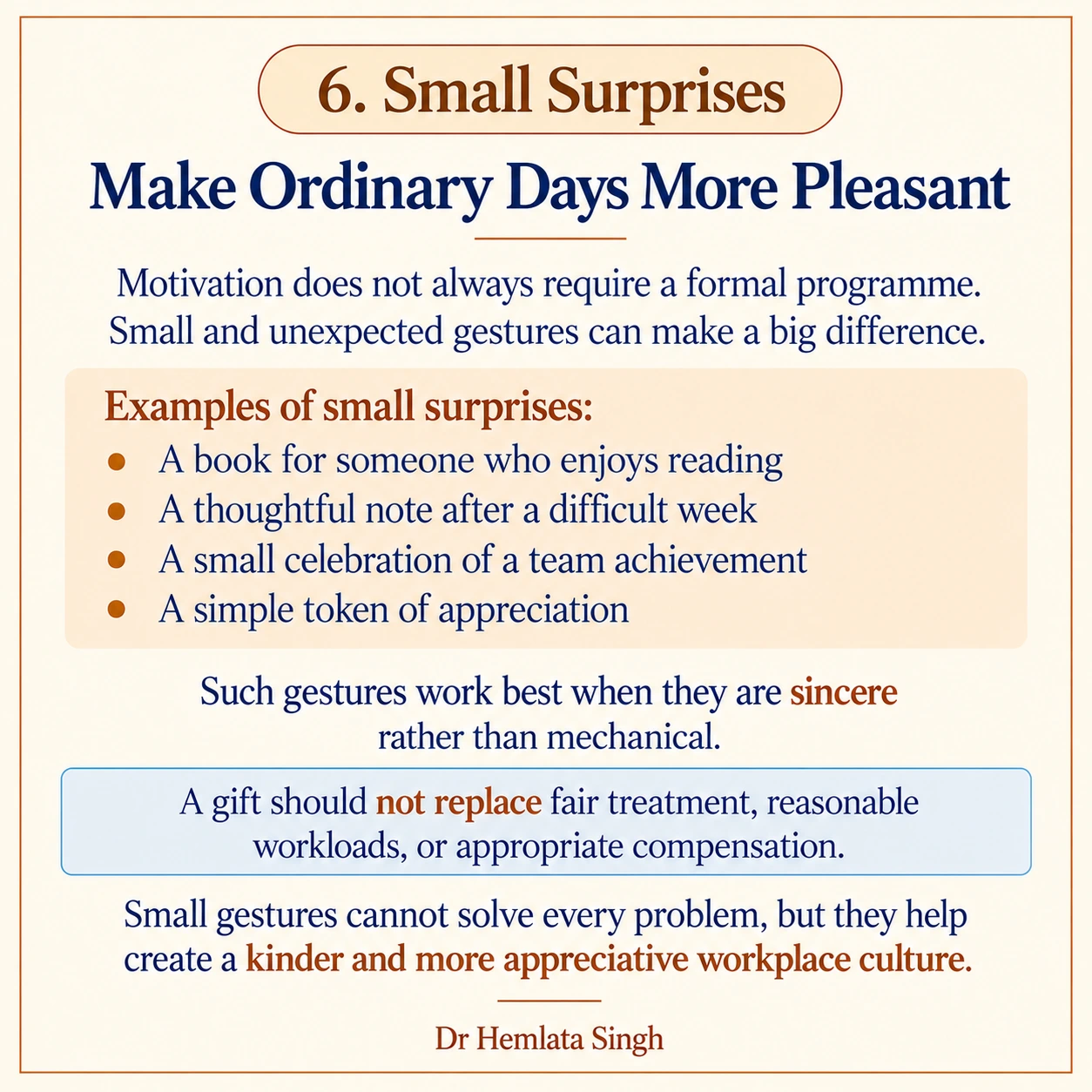
6. Small Surprises: Make Ordinary Days More Pleasant
Motivation does not always require a formal programme.
Sometimes, small and unexpected gestures can make an ordinary workday feel different.
A book gifted to an employee who enjoys reading, a thoughtful note after a difficult week, a small celebration of a team achievement, or a simple token of appreciation can communicate that people are valued beyond their job descriptions.
Such gestures are most effective when they are sincere rather than mechanical.
A gift should not become a substitute for fair treatment, reasonable workloads, or appropriate compensation. Its purpose is to strengthen the human connection within the workplace.
Small gestures cannot solve every problem, but they can help create a culture in which kindness and appreciation become part of everyday working life.
7. Visible Progress: Help Employees See How Far They Have Come
One reason routine work becomes discouraging is that progress is not always obvious.
An employee may complete dozens of assignments each month without ever receiving a clear picture of what has improved.
A simple system of monthly or quarterly feedback can make achievements more visible.
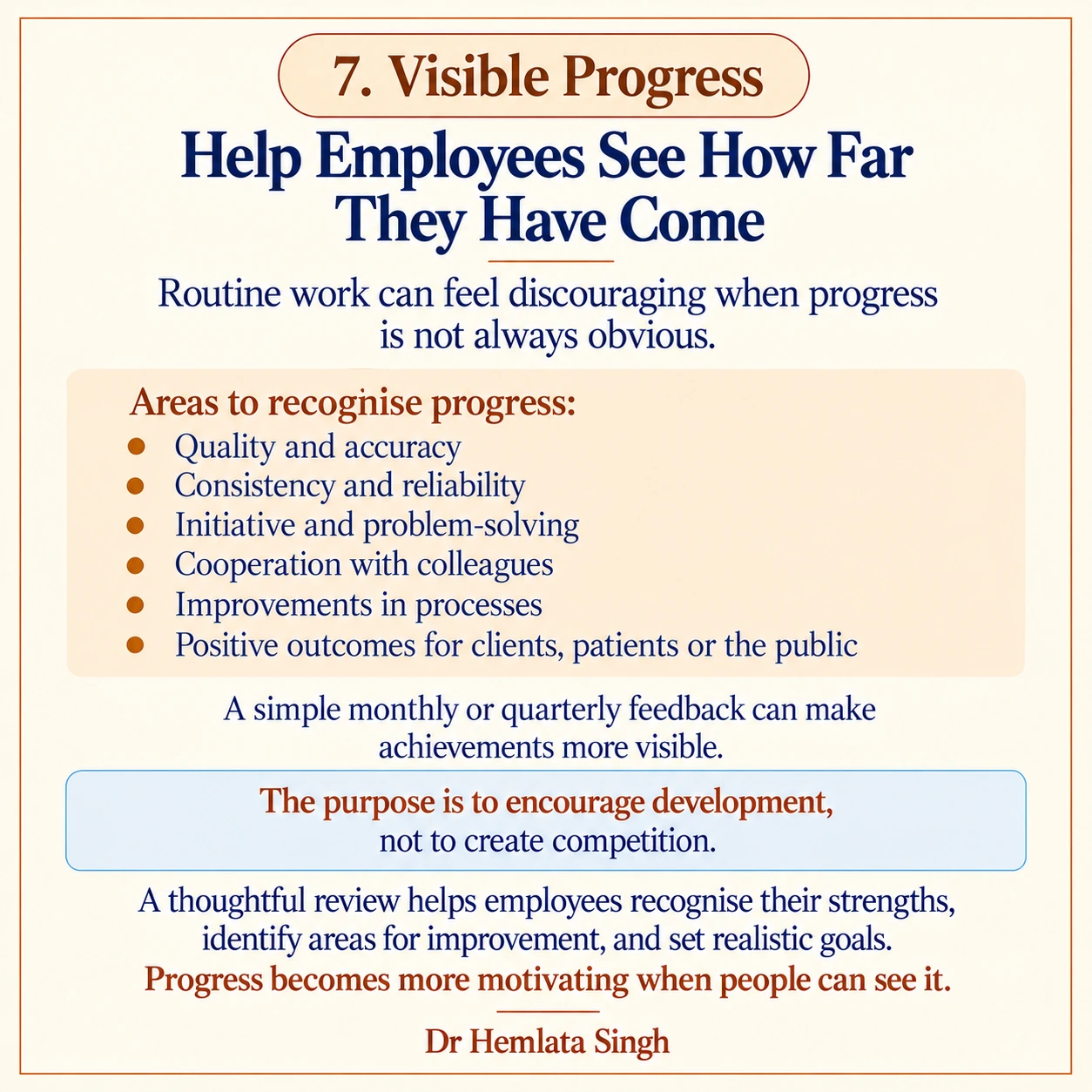
Depending on the nature of the work, progress might be assessed through:
- Quality and accuracy.
- Consistency and reliability.
- Initiative and problem-solving.
- Cooperation with colleagues.
- Improvements in existing processes.
- Positive outcomes for clients, patients, or the public.
The purpose should be to encourage development, not to turn every activity into a competition.
Not all valuable contributions can be measured numerically. Good judgment, dependability, empathy, and behind-the-scenes support also matter.
A thoughtful review can help employees recognise their strengths, identify areas for improvement, and set realistic goals for the coming months.
Progress becomes more motivating when people can see it.
8. Employee Participation: Ask Before Designing Incentives
Managers sometimes introduce rewards based on what they believe employees should want.
Yet, different people are motivated by different things.
One employee may value professional development, another may appreciate flexible hours, while someone else may prefer public recognition or a challenging new responsibility.
Instead of guessing, organisations can ask employees directly.
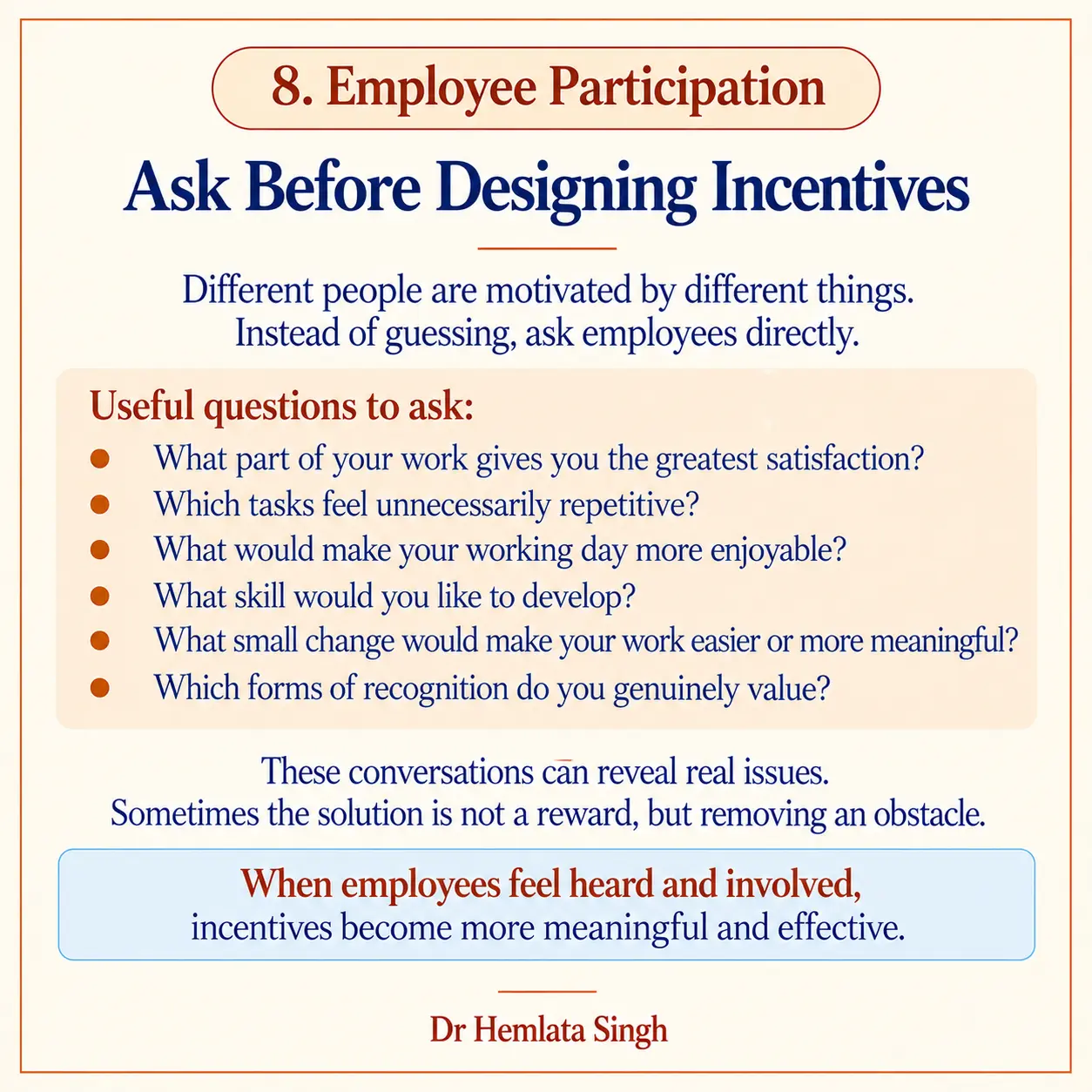
Questions might include:
- What part of your work gives you the greatest satisfaction?
- Which aspects of your daily routine feel unnecessarily repetitive?
- What would make your working day more enjoyable?
- What skill would you like to develop?
- What small change would make your work easier or more meaningful?
- Which forms of recognition do you genuinely value?
These conversations can reveal problems that incentives alone cannot solve.
Perhaps a repetitive administrative process needs simplification. Perhaps employees lack the equipment required to do their jobs efficiently. Perhaps responsibilities are distributed unfairly.
Sometimes, the most effective way to motivate people is not to add a reward but to remove an obstacle.
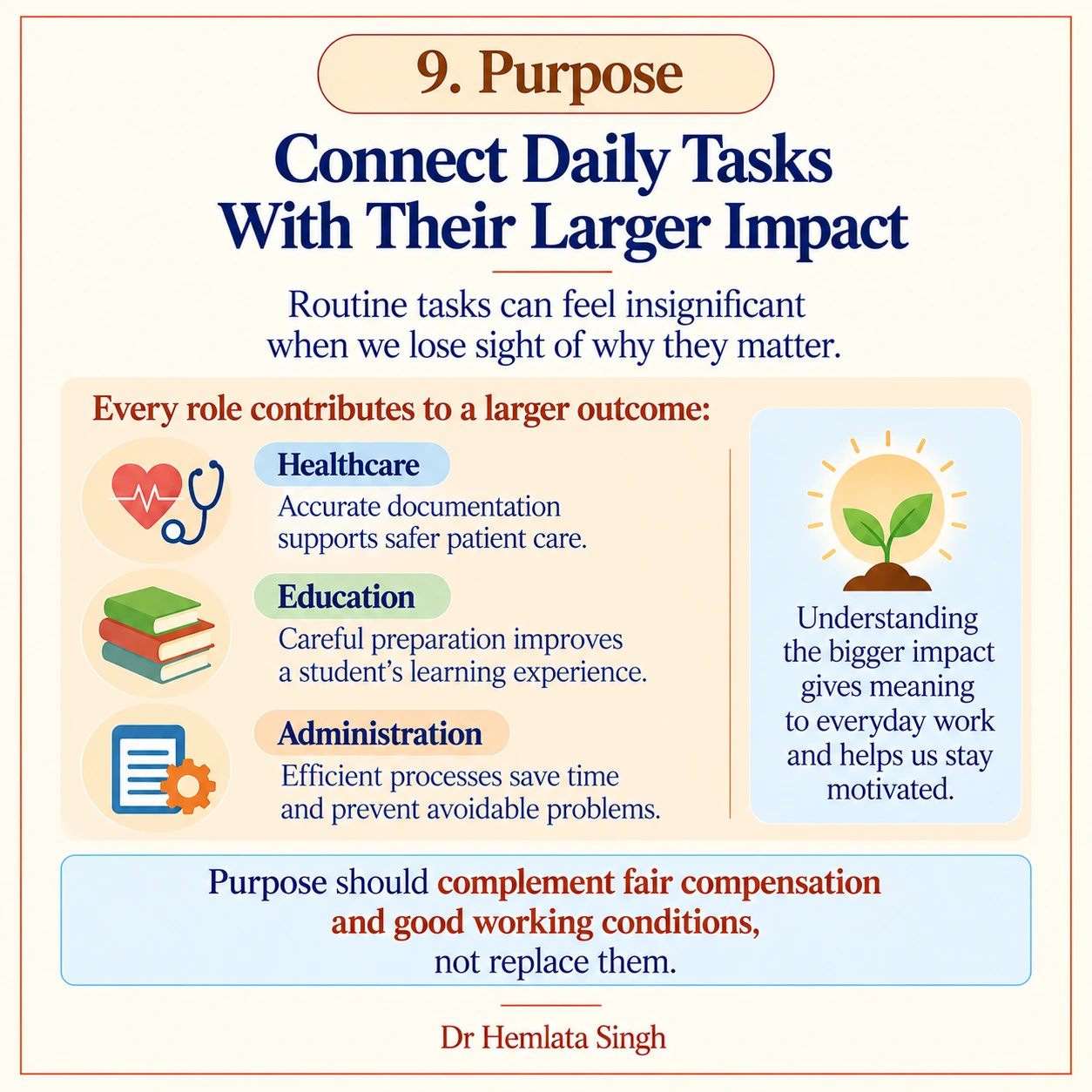
9. Purpose: Connect Daily Tasks With Their Larger Impact
Routine responsibilities can feel insignificant when employees lose sight of why their work matters.
A report becomes just another report. A patient record becomes just another file. A customer query becomes just another task to complete.
But every role contributes to a larger outcome.
In healthcare, accurate documentation can support safer patient care. In education, careful preparation can improve a student’s learning experience. In administration, efficient processes can save time and prevent avoidable problems.
Managers can help employees recognise these connections by sharing meaningful feedback, discussing the impact of completed projects, and acknowledging the people who benefit from their work.
In professions centred on service, this connection can be particularly important.
However, purpose should complement fair compensation and working conditions, not replace them. Employees should not be expected to accept unfair treatment simply because their work serves a worthwhile cause.
A meaningful job is one in which people can recognise both the value of their contribution and the value of their own time and effort.
10. Build a Culture of Continuous Encouragement
Motivation is unlikely to improve through a single annual award or an occasional speech.
It is more likely to develop through consistent practices that make employees feel respected, supported, and capable of progress.
An organisation could introduce a simple rhythm of encouragement:
Weekly: Acknowledge a meaningful contribution or share positive feedback.
Monthly: Recognise achievements, improvements, and constructive initiatives.
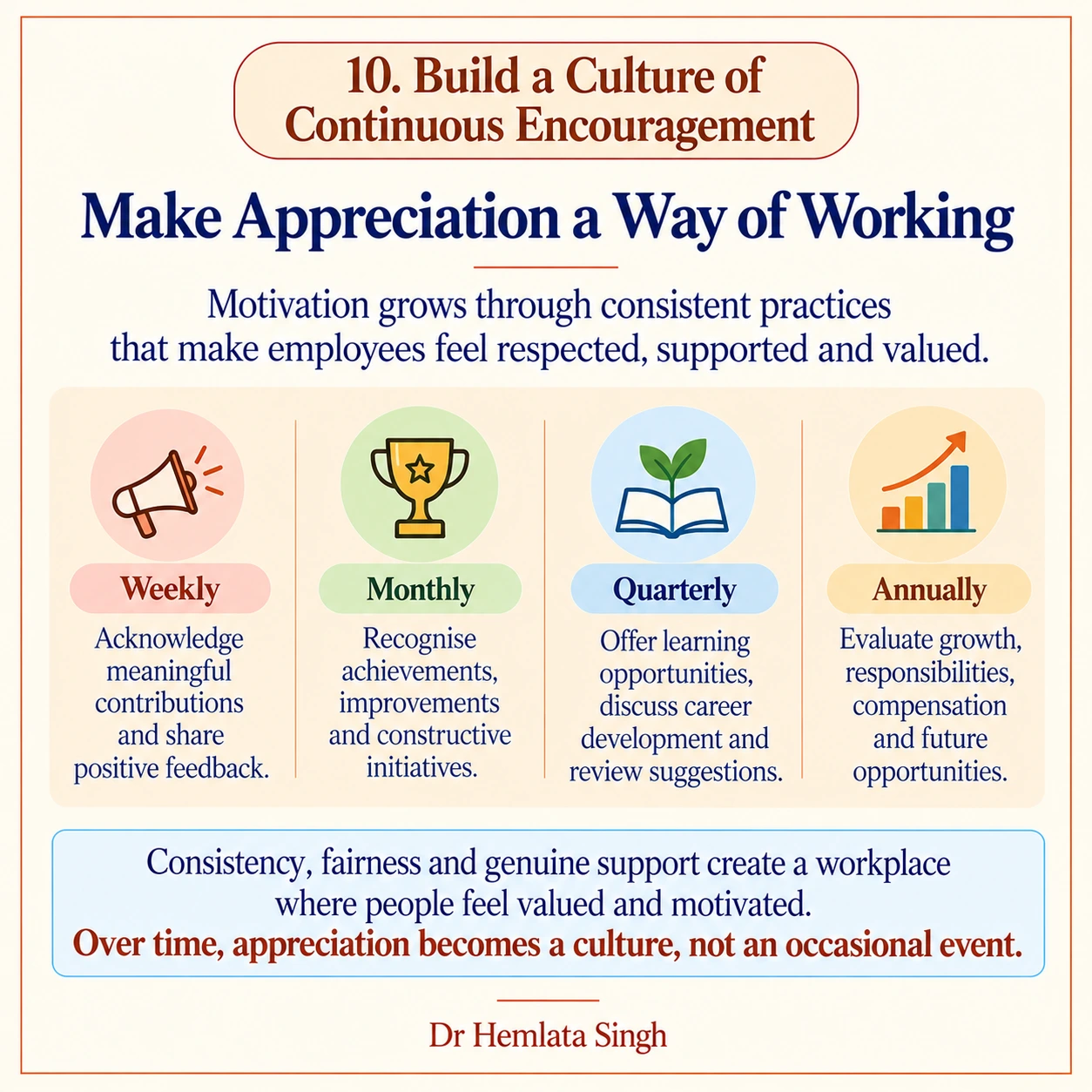
Quarterly: Offer learning opportunities, discuss career development, and review employee suggestions.
Annually: Evaluate professional growth, responsibilities, compensation, and future opportunities.
The process need not be complicated or expensive. What matters is consistency, fairness, and a genuine interest in employee development.
Recognition should not always go to the same individuals. Managers should make an effort to notice different forms of contribution, including those that are less visible.
Over time, these practices can help make appreciation and improvement part of the workplace culture rather than occasional events.
A Practical Model: The Four-R Approach
For organisations looking for a simple starting point, the following four-part framework can be useful.
1. Recognition
Acknowledge specific contributions and make employees feel that their efforts matter.
2. Responsibility
Offer meaningful ownership, appropriate independence, and opportunities to contribute ideas.
3. Renewal
Introduce learning, new challenges, and small changes that prevent work from becoming completely repetitive.
4. Reward
Provide fair, transparent incentives for exceptional contributions, using financial or non-financial benefits according to the organisation’s resources and policies.
Together, these four elements offer a practical way to encourage enthusiasm without making salary increases the only available tool.
An organisation can begin with a small pilot, seek employee feedback, and evaluate whether the changes improve satisfaction, initiative, and the quality of work.
An Important Distinction: Motivation Is Not a Substitute for Fairness
Before introducing an incentive system, employers must understand why enthusiasm has declined.
If employees are bored, new challenges and greater autonomy may help.
If they feel invisible, appreciation and constructive feedback may make a difference.
If they feel professionally stagnant, learning opportunities may restore their sense of progress.
But if employees are underpaid, overworked, treated unfairly, or denied reasonable opportunities for advancement, small gifts and certificates will not address the underlying problem.
Financial compensation remains important. Non-financial incentives should complement fair salaries, manageable workloads, respectful leadership, and appropriate working conditions.
There is also a difference between encouraging employees to contribute meaningfully and expecting them to perform beyond their responsibilities without suitable recognition.
A healthy incentive system does not manipulate people into doing more. It creates conditions in which people have good reasons to care about the quality of their work.
A Simple Challenge for Every Leader
You do not need to introduce ten new initiatives next Monday.
Start with three small questions:
- What is one thing I can do this week to make someone’s work easier?
- Whose contribution have I overlooked and should acknowledge?
- What is one unnecessary difficulty in our workplace that I can help remove?
Choose one practical action and follow through.
Next week, try another.
Over time, these small actions can help create a workplace where people feel heard, recognised, and encouraged to contribute.
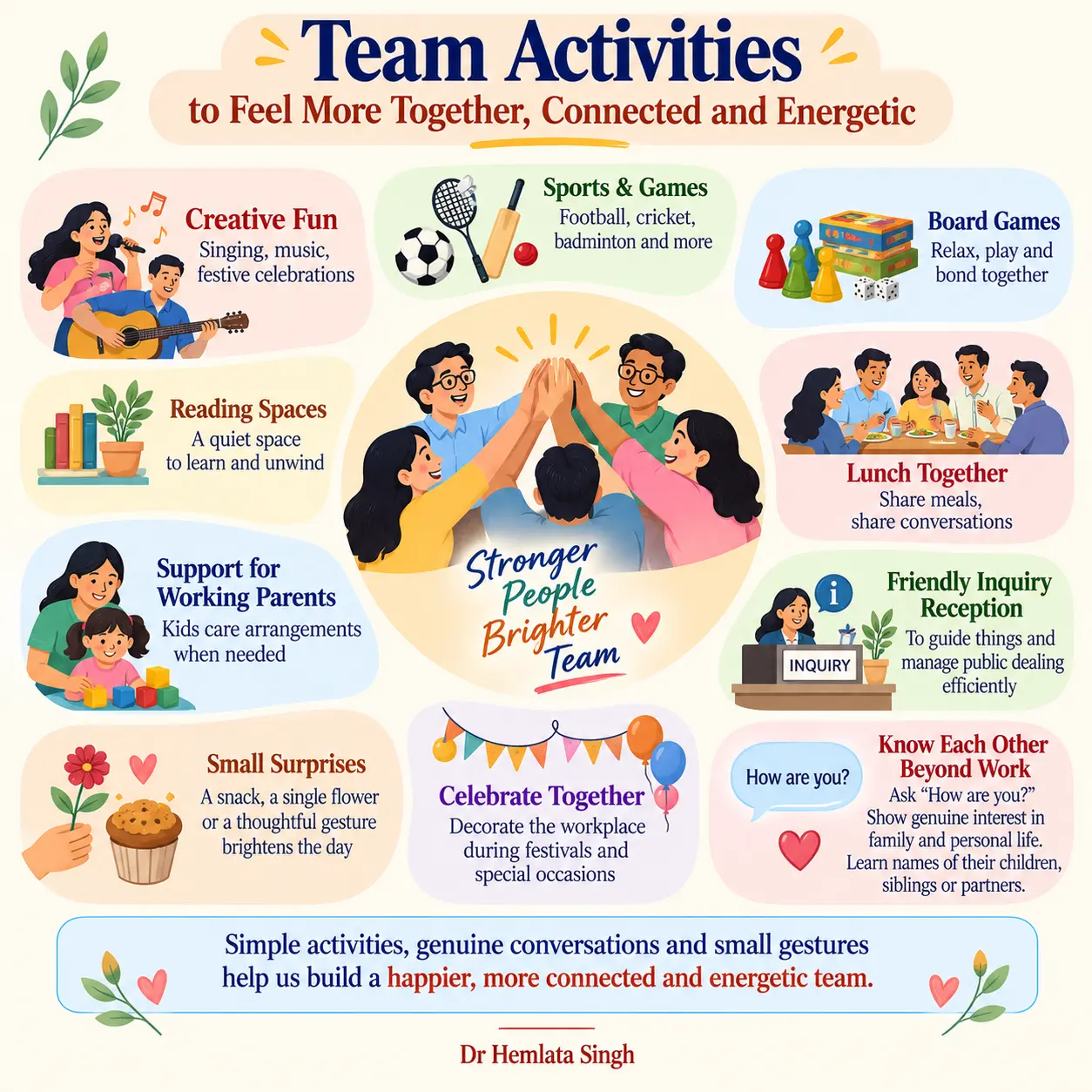
Team activities can help employees feel more connected, energetic, and comfortable with one another. Singing, music, football, cricket, badminton, board games, and other recreational activities provide opportunities to relax, share laughter, and build stronger relationships. Reading spaces, lunch together, childcare arrangements where feasible, and collective celebration of festivals can make the workplace more welcoming and supportive. Small surprises, such as a thoughtful note, a snack, or a single flower, can bring warmth to an ordinary working day.
Institutions should also establish a well-organised inquiry and reception desk to guide visitors and manage public interactions efficiently. Equally important is developing a habit of asking colleagues, “How are you?” and “How is everything going at home?” Taking a genuine interest in one another’s lives, remembering the names of colleagues’ children, siblings, or partners, and listening with empathy can help build meaningful connections beyond work.
A workplace becomes a stronger team when people work together with enthusiasm, care for one another, and keep empathy in their hearts.
The Real Art of Motivation
Perhaps the art of motivation lies less in grand speeches and expensive incentives and more in the atmosphere we create every day.
A leader who listens. A colleague who offers help. A team that shares a laugh. A workplace that welcomes visitors warmly. An opportunity to learn something new. A sincere thank-you at the end of a difficult day.
None of these actions guarantees enthusiasm, and no single approach works for everyone. But together, they can help make work more humane and rewarding.
We may not always be able to change salaries, working hours, institutional policies, or the demands of our profession. Yet, within the limits of our responsibilities, we can influence how we treat one another and how we respond to the challenges we share.
And perhaps that is where motivation begins—not in asking people to smile through every difficulty, but in giving them genuine reasons to feel supported, respected, and proud of their work.
A good institution gets the work done. A great one remembers the people who make it possible.